TOP 5 Heat Sinks TOP 5 Low Profile Heat Sinks TOP 5 Liquid Coolers
Heatsinks by Brand / Mfgr Reviews + Articless Advanced Search
|
TOP 5 Heat Sinks TOP 5 Low Profile Heat Sinks TOP 5 Liquid Coolers Heatsinks by Brand / Mfgr Reviews + Articless Advanced Search |
Thermal Integration TI-RV104N Heatsink Review The forked-fins of this extruded aluminum heatsink make it pretty evolutionary for its class; especially considering Intel's recently announced bifurcated reference heatsink for the socket 775 Tejas-FMB1. The 'sun' shape of the Thermal Integration TI-RV104N, with copper in the center surrounded by aluminum, is a hint of what you can expect when computers make the switch to socket 775 - only the heatsink will be about 80mm in diameter. In the past we have tested a couple heatsinks made by AVC of very similar design to the TI-RV104N which exhibited very good performance, so I would expect nothing less from Thermal Integration's socket 478 Pentium 4 cooler. In any case, at the center of the TI-RV104N we find a hefty copper slug measuring 34mm in diameter, larger than most other copper slugs in fact. with a diameter that large, it leads me to wonder if plans aren't also in the works to come out with a Socket 754 Athlon64 version based on the TI-RV104N. In any case, it is too early for that so let's get started and see how the Thermal Integration TI-RV104N performs thermally, and acoustically!
The copper core which measures 39mm in diameter forms the contact area of the heatsink, and through an interference joint with the surrounding aluminum transfers whatever heat it absorb's out to the many thin bifurcated (forked) aluminum fins. The fins themselves are just 1mm thick at the base, but branch out with a slight curve to ~2mm thickness before forking into two 0.3mm thick fins. It is difficult to say how effectively the heat energy will flow out to the edges of the aluminum fins at this point, but the designers have certainly gone a long way to keeping surface area high, and problems with back pressure low.
|
 |
|
| |||||||||||||||||||||||||||||
|
Find a Heatsink . Latest Heatsink Reviews . Top 5 Heatsinks Tested . Top 5 Low Profile Heatsinks . Top 5 Liquid Coolers . Heatsinks by Mfgr / Brand |
Social Media |
FrostyTech.com Info . Feedback . Contact Us / Heatsink Submissions . Submit News . Privacy Policy |
 | |
© Copyright 1999-2025 www.frostytech.com All Rights Reserved. Privacy policy and Terms of Use Images © FrostyTech.com and may not be reproduced without express written permission. Current students and faculty of accredited Universities may use Frostytech images in research papers and thesis, provided each image is attributed. | ||||

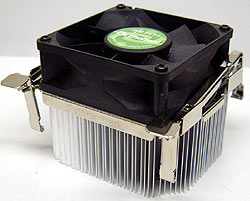


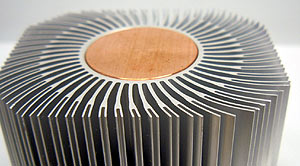 The TI-RV104N is an extruded aluminum
heatsink, but there are several differences between it and what most of us are used to seeing. For starters,
the main components of the heatsink are all very thin - typically no more
than 2mm thick at the widest.
The TI-RV104N is an extruded aluminum
heatsink, but there are several differences between it and what most of us are used to seeing. For starters,
the main components of the heatsink are all very thin - typically no more
than 2mm thick at the widest.