TOP 5 Heat Sinks TOP 5 Low Profile Heat Sinks TOP 5 Liquid Coolers
Heatsinks by Brand / Mfgr Reviews + Articless Advanced Search
|
TOP 5 Heat Sinks TOP 5 Low Profile Heat Sinks TOP 5 Liquid Coolers Heatsinks by Brand / Mfgr Reviews + Articless Advanced Search |
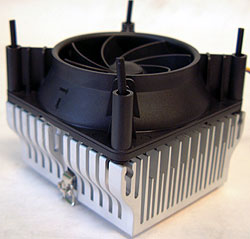
Verax P14Cu Copper Base Heatsink Review Leave it up to the German's to take a simple heatsink and mix in Cold Gas Dynamic Spray technology, a 3mm thick copper base plate, and top it off with a completely revolutionary CAIRdB fan. As if that isn't enough already, the temperature sensitive 80251235-KP2 CAIRdB fan is virtually silent under power, and is even held in place on the aluminum heatsink with four vibration dampening rubber posts. All of this engineering comes from one company by the name of Verax Ventilatoren GmbH (Veraxfans.com ) and I have a feeling this is going to make for one very interesting heatsink review... Though before we touch on what exactly Cold Gas Dynamic Spraying has to do with making the Verax P14Cu heatsink 'better', let's focus for a second on that crazy looking fan below.  The Verax CAIRdB thermally
controlled fans are one the most unique zero-noise fans in the
marketplace that we have tested. The stealthy acoustical act
is accomplished by tossing out convention and starting with
a completely fresh impeller design. It's not surprising to discover
that the company that created these fans has its background in
research & development of fluid engineering. The Verax CAIRdB thermally
controlled fans are one the most unique zero-noise fans in the
marketplace that we have tested. The stealthy acoustical act
is accomplished by tossing out convention and starting with
a completely fresh impeller design. It's not surprising to discover
that the company that created these fans has its background in
research & development of fluid engineering.
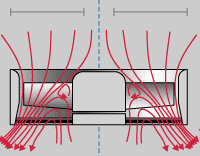
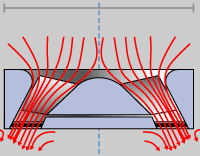
So quiet are the Verax CAIRdB fans that you literally have to hold one up to your ear to hear anything - there is almost no discernible noise signature till the fand starts to kick into the 2000RPM range around 40 degrees Celsius. Even then, compared to other socket A heatsinks the CAIRdB KP2 fan is still positively quiet. The fan actually scales in speed from about 1000RPM - 3500RPM over a temperature range of 20-45 degrees Celsius. An embedded thermistor in one of the motor support struts samples air temperature continuously and lets the fan respond as case temperature increases. We've been critical of the thermistor placement on the CAIRdB fans, especially when they are used for heatsinks, so as with all previous Verax heatsink reviews we gently popped the thermistor out of its cavity and bent it over so it is closer to the actual aluminum fins of the heatsink. Since this is a thermally responsive fan, the sound levels will increase to about 42dB from 31.2dB (according to our instruments which were faced with levels below their calibrated range) at max RPM. The only trade off comes in terms of cost, and in measurably lower airflow to that of standard hi-RPM vaneaxial fan. An 80mm Verax fan like the CAIRdB KP2 is extremely quiet, but it retails for about $40USD by itself. The trend setting impeller of the fan works by accelerating air between its blades evenly, over a substantially longer distance than standard vaneaxial fans. This keeps turbulent noises down as the impeller rotates counter-clockwise - totally opposite to that of traditional axial fans.
|
 |
|
| |||||||||||||||||||||||||||||||
|
Find a Heatsink . Latest Heatsink Reviews . Top 5 Heatsinks Tested . Top 5 Low Profile Heatsinks . Top 5 Liquid Coolers . Heatsinks by Mfgr / Brand |
Social Media |
FrostyTech.com Info . Feedback . Contact Us / Heatsink Submissions . Submit News . Privacy Policy |
 | |
© Copyright 1999-2023 www.frostytech.com All Rights Reserved. Privacy policy and Terms of Use Images © FrostyTech.com and may not be reproduced without express written permission. Current students and faculty of accredited Universities may use Frostytech images in research papers and thesis, provided each image is attributed. | ||||