TOP 5 Heat Sinks TOP 5 Low Profile Heat Sinks TOP 5 Liquid Coolers
Heatsinks by Brand / Mfgr Reviews + Articless Advanced Search
|
TOP 5 Heat Sinks TOP 5 Low Profile Heat Sinks TOP 5 Liquid Coolers Heatsinks by Brand / Mfgr Reviews + Articless Advanced Search |
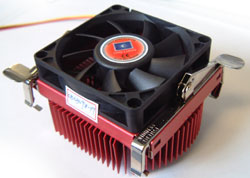
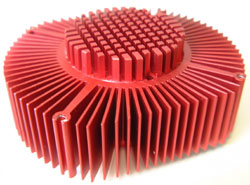
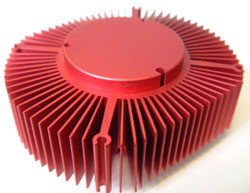
ChoLiang CB0309Z17 P4 m478 Heatsink Review From the outset this you can tell that is one different heatsink just by the way it looks. The radial fin concept has been in use since early in the year, and more than a few companies have picked up on it, releasing their own special variations of the design. Cho Liang released the CB0309Z17 at this years Computex and I'm sure it garnered a lot of attention from the crowd. As someone who has reviewed upwards of 180 heatsinks, this little guy has a lot of potential, especially if we think about what could be done with some well-placed heat pipes! In any case, the bright-red anodized CB0309Z17 is for the socket 478 pentium 4 processor and it will be interesting to see how the results fare against other more traditional heatsinks so let's get started!
It should be common knowledge by now that the size of the fan can only improve the performance of a heatsink so much. The basis of those performance increases will always be the design of the heatsink itself, the surface area of the fins, and how well heat transfers from the processor core to the body of metal. A great fin design can be handicapped by a poor thermal interface between the processor and the heatsink, and a great thermal interface can be useless if the heatsink fin design is useless. In the case of the Cho-Liang CB0309Z17 we can see a good looking base and a good looking fin design... but a possible problem right between the two.
Looking at the ChoLiang CB0309Z17 we noticed right off the bat that the center section and the fin section are two different pieces of anodized aluminum. While this is not necessarily a bad thing, this could affect overall heatsink performance by a large degree. The problems could stem from the thermal joint in one of few ways. If the interface between the two pieces of metal is not tight enough heat energy trying to pass between the two will be faced with an air gap. This could be partially resolved with the use of a thermal compound between the two pieces, but it doesn't appear that any was used. The other main issue which could hamper the thermal interface is the anodizing of the aluminum itself. Since this layer is crystalline, it inhibits thermal transfer. Without redesigning the entire die for this heatsink there are few fixes which could possibly help overall performance. Reaming out the center area to bare aluminum, and turning the outer layer of the central core down to bare aluminum would help alleviate the problems of thermal transfer as long as the interface between the two surfaces were very tight. This is of course something we can't test out first hand, so let's see what kind of results the CB0309Z17 generates for it self in its current configuration!
|
 |
|
| |||||||||||||||||||||||||||||||||
|
Find a Heatsink . Latest Heatsink Reviews . Top 5 Heatsinks Tested . Top 5 Low Profile Heatsinks . Top 5 Liquid Coolers . Heatsinks by Mfgr / Brand |
Social Media |
FrostyTech.com Info . Feedback . Contact Us / Heatsink Submissions . Submit News . Privacy Policy |
 | |
© Copyright 1999-2023 www.frostytech.com All Rights Reserved. Privacy policy and Terms of Use Images © FrostyTech.com and may not be reproduced without express written permission. Current students and faculty of accredited Universities may use Frostytech images in research papers and thesis, provided each image is attributed. | ||||